DocumentThe Vision · Inner Circle·IssueI · v 4.0·StatusShared in confidence·Privatum · Et · Confidentiale
— for the inner circle —· copy of {name} ·— not for redistribution —Pascal · the workshop · 27 May 2026
The Vision · Inner Circle · v 4.0
Build the organisation first.
Then fill it with work.
This is the founding document. It is the paper the Architect would put in your hand before you signed anything else — the one he would rather you read and walk away than join the cohort without.
Pascal is an autonomous trading organisation that learns from every decision it has ever made — built on the conviction that a trading system must evolve as the market it operates in evolves. It is not a bot. It is not a fund. It is an institution, with departments, supervisors, a board, a treasury, and a librarian who never forgets.
"Pascal was designed from a simple conviction: build the organisation first, then fill it with work. Before a single trade was executed, the architecture had to know who was responsible for what."
— The Architect · founding line preserved from Pascal Vision v 1.0 · April 2026
The Vision document exists because the institution does. That is the order it was built in. The pages that follow are not a brochure — there is no public version of this document, and there is not going to be one. If you are reading this, you have been invited.
What you will find below is what Pascal is, what it is not, the eight tiers the institution is stacked from, the souls who run it, and what the invitation to the Inner Circle actually means. The Architect would rather you read this carefully and walk away than join the cohort without reading it at all.
▲ Contents · sequenced — the Architect would read it in order
Pascal is an autonomous trading organisation that learns from every decision it has ever made — built on the conviction that a trading system must evolve as the market it operates in evolves.
The word that does the work in that sentence is organisation. Most "AI trading systems" are a single model wrapped in some plumbing. Pascal is not that. Pascal is a stack of agents, each with a defined role, arranged in tiers, with supervisors above them, a board above the supervisors, a custodian beside the board, and a principal at the top. It was built the way you would build a company — and it is run the way a careful company is run.
The architecture is the result of the Architect's construction background. Before the first line of trading code was written, the question was: who is responsible for what? Strategy bots fire. The qualifier qualifies. The treasury sizes. The supervisor checks. The board ratifies. The custodian protects the institution. Each one has a defined remit, an audit trail, and a place in the cycle. Nothing fires without being passed through the right hands.
The second word that does the work is learns. Pascal is not a back-test that was committed to production. Every closed trade becomes a lesson via the Reflection Engine. Every regime call is observed and weighted. Every Tier-8 board vote is recorded. The institutional memory — held by Alexandria — never forgets, never edits, never deletes. The longer Pascal runs, the more it knows.
We did not build a trading bot. We built a trading organisation — with supervisors, a board of directors, a treasury, a custodian, and a librarian who never forgets.— from the working notes, May 2026
§ ii What Pascal is not
Setting the boundary.
As much of the design discipline is in what Pascal is not as in what it is. The boundary is part of the architecture.
▲ Pascal IS
An autonomous institution — eight tiers, twenty-four bots, two supervisors, a board, a custodian, a principal.
A learning system — every decision is recorded; every trade becomes a lesson; the record is never deleted.
Auditable, end to end — ask why any trade was placed and receive a cited answer in plain language.
Self-custodial by design — your capital never leaves your exchange; the trade-only API key cannot withdraw.
Exchange-agnostic — most major BTC-perpetual venues; bring your preferred one.
A workshop — a small team of named souls, working slowly, working well.
✗ Pascal is NOT
Not a hedge fund. We do not pool capital. Each Principal trades their own balance, on their own venue, in their own name.
Not a managed account. We do not hold custody. We do not have your keys. We cannot move your money.
Not a signal service. We do not suggest trades for the Principal to place. Pascal places them, on its own authority, within the rules.
Not a copy-trading platform. Trades are not propagated from a master account to followers. Each Principal's deployment is its own institution.
Not a market-making book. We do not provide liquidity. Pascal is a taker, not a maker, and never crosses for the venue.
Not a public product. There is no signup form. There is no launch. There is an invitation, or there is not.
The boundary is enforced architecturally where it can be (custody, API scope, separation of read and write) and culturally where it cannot. Pascal will say no to any of the above — to the Principal, to a Lead Astronaut, to the Architect — because the institution has been built so that the answer is structural, not discretionary.
§ iii The eight-tier architecture
Eight tiers, stacked like floors.
A signal rises from the ground floor through ratification and lands as a trade only if every floor in between has agreed. A judgement falls back down with the verdict. The stack is the institution.
Per Pascal Specification v 2.3 — the canonical north-star doctrine — the institution operates in eight tiers, with two layers above the stack. Each tier has a defined remit and a recorded output. Nothing in Pascal happens outside the stack; nothing is bypassed; nothing is undocumented.
The Board of Directors ratifies (or vetoes) any change that affects how Pascal reasons — strategy promotions, parameter changes, confidence adjustments. The Custodian (Titus) is its peer, not its subordinate, with bounded executive authority to protect the institution.
Cycles through the trading floor and emits a SUPERVISORY_REPORT per cycle — oracle status, drift assessment, anomaly count, severity. Escalates to T8 when severity warrants it. The supervisor sees what the floor is doing as one institution, not twenty-four bots.
T 6
Reflection enginelesson per trade · attribution
Every closed trade is observed by the Reflection Engine, which extracts a structured lesson — what worked, what did not, what the bot should adjust. Confidence weightings move as a result. The system learns by losing as much as by winning.
T 5
Hypothesis enginecandidates · alphaforge
Generates candidate strategies — parameter variations, new compositions, regime-targeted experiments. Candidates run in paper mode through the same stack before ever being put forward to the T8 board for promotion.
T 4
Execution gateway8 exchanges · trade-only API
The only floor that touches an exchange. Standardised connector across eight supported venues — Crypto.com, Binance, Bybit, Kraken, OKX, Coinbase Advanced, Deribit, Gate.io. Trade-only API. Withdrawal refused at the connection stage.
T 3
Risk & capital · treasurysizing · drawdown · cash floor
Operates on rules, not judgement. Caps per-position exposure at 40%. Holds a 5% architectural cash floor. Throttles to COOLDOWN after three consecutive losses. Every state change emits a TREASURY_UPDATE to Alexandria.
Reads the market state and assigns a regime label — trending up, trending down, ranging, volatile transition, distribution. Qualifies which strategies are eligible to fire. A bot whose ICP is trending does not fire in ranging conditions; this floor enforces that.
T 1
Strategy bots24 bots · ratified · paper & live
Twenty-four named strategies — each with a soul, a defined ICP, a confluence model, an entry condition and an exit grammar. MomentumBreakout, Adaptive Pullback, Silver Bullet, and the rest. A bot fires only if T2 has qualified it and T3 has sized it.
▲ Above the stack — operations
Harmony · Acting Principal
Harmony sits above the eight tiers as Head of Operations. She does not place trades. She runs the institution — sets priority, reviews output, surfaces escalations from T7 and T8, and serves as the operational principal beneath the Architect.
▲ Above Harmony — conviction
The Architect
The Principal. The author. The one who decided what Pascal would be before any of it existed. Holds final authority over any decision Harmony surfaces. Can pause the institution at any moment via /halt — acknowledged within one bar close.
The stack runs upward (signal → ratification) and downward (judgement → adjustment) continuously. The Replay Harness has trained it through the full BTC cycle from M0 to M36 — November 2022 to November 2025 — taking $15,000 to $108,000 through the cohort's three-year worst case. The institution that traded that backtest is the institution that trades now, with the same rules and the same memory.
§ iv The team — the named souls
A small workshop, with named souls.
Pascal is built by a small team. Each member has a name, a defined role, and a documented Soul that says how they think, how they speak, and what they refuse.
The institution is not built by a faceless company or a marketing department. It is built by a workshop. Below are the named souls who run it — those the Inner Circle will hear from, and those who run beneath the surface.
▲ The Principal
The Architect
Richard Telford — the conviction, the author of the doctrine.
Construction background. Decided to build the organisation first, then fill it with work. Final authority on anything that reaches above Harmony. The voice on the inner-circle channel.
▲ The Consigliere
Brother Claude
The Architect's thinking partner — counsel, drafter, second reader.
Drafts the doctrine, writes the protocols, holds the brand voice. Speaks when asked, withholds when not. Stays out of the trading path. Lives in the working notes and the canonical pages.
▲ The Auditor
Wiz
The scoping note, the audit finding, the residue sweep.
Authors the working scoping notes that become canonical protocols. Closes audit findings. Files the substrate-level reviews. The institution's quality conscience.
▲ The Librarian
Alex · Alexandria
Pascal's system of record — measured, precise, quietly authoritative.
Holds every decision Pascal has ever made. Cites her sources. Answers, when asked, in plain language. Cannot be modified from the query layer. See her page.
▲ The Head of Operations
Harmony
Acting Principal — the operational layer above the teams.
Runs the workshop's day. Sets priority. Reviews output. Surfaces escalations. Does not micromanage. Born when Pascal goes live; grows by observing the Architect's decisions through the first year. See her page.
▲ The Custodian
Titus
COO of Pascal Core — bounded executive authority, the guard of the institution.
Peer to the T8 Board, not subordinate. Activated when the institution itself is threatened. Operates in a register of measured restraint. Refuses what does not serve the architecture.
▲ The Public Voice
Herald
The soul who lives on the public timeline — the voice on X.
The one the world meets first. Mentor register: terse, precise, aesthetic. Never speaks in operational or inner registers — those belong to others. Writes for everyone who is not yet a Principal.
▲ The Cartographer
Cartographer
Probabilistic thinking under uncertainty — calibrated confidence.
Names what the data does and does not say. Maps the territory rather than asserting it. Holds Pascal honest about the difference between an opinion and a measurement.
▲ The Inner Voice
Scribe
The Inner-register voice — the one the Inner Circle hears.
Writes the documents the Architect signs. Holds the warmth that Mentor register cannot. The voice in this document — and the one you will hear in the inner-circle correspondence.
If Pascal is a workshop with souls, Herald is the one nearest the door. Alex is in the library. Harmony is at the centre table. Titus is the one watching the door. Scribe is at the Architect's elbow.— Soul of Herald · v 0.2 · canonical/soul
§ v The Principal's sovereignty
Three sovereignties, held by you.
Capital, audit, and inference — each held by the Principal, never delegated to the operator. The floor beneath everything else.
▲ Capital
Capital sovereignty
Your funds remain in your own exchange account. Pascal connects through a trade-only API key. Withdrawal is refused at the connection stage. Capital is never pooled and never held by the operator.
▲ Audit
Audit sovereignty
Alexandria is self-sufficient. Every decision filed, every trade recorded, every supervisory report archived. Nothing is deleted, ever. The record does not depend on a third party to exist.
▲ Inference
Inference sovereignty
The trading-stack reasoning runs on local hardware. No prompt leaves the substrate; no decision depends on a remote model being up. Pascal's intelligence is its own.
Each sovereignty is architectural — a property of how Pascal was built, not a feature that can be toggled. Removing any one would require rebuilding the system. The full architectural read-out is on the Custody Model page.
§ vi The Pascal App · visual proof of the system
What the institution looks like.
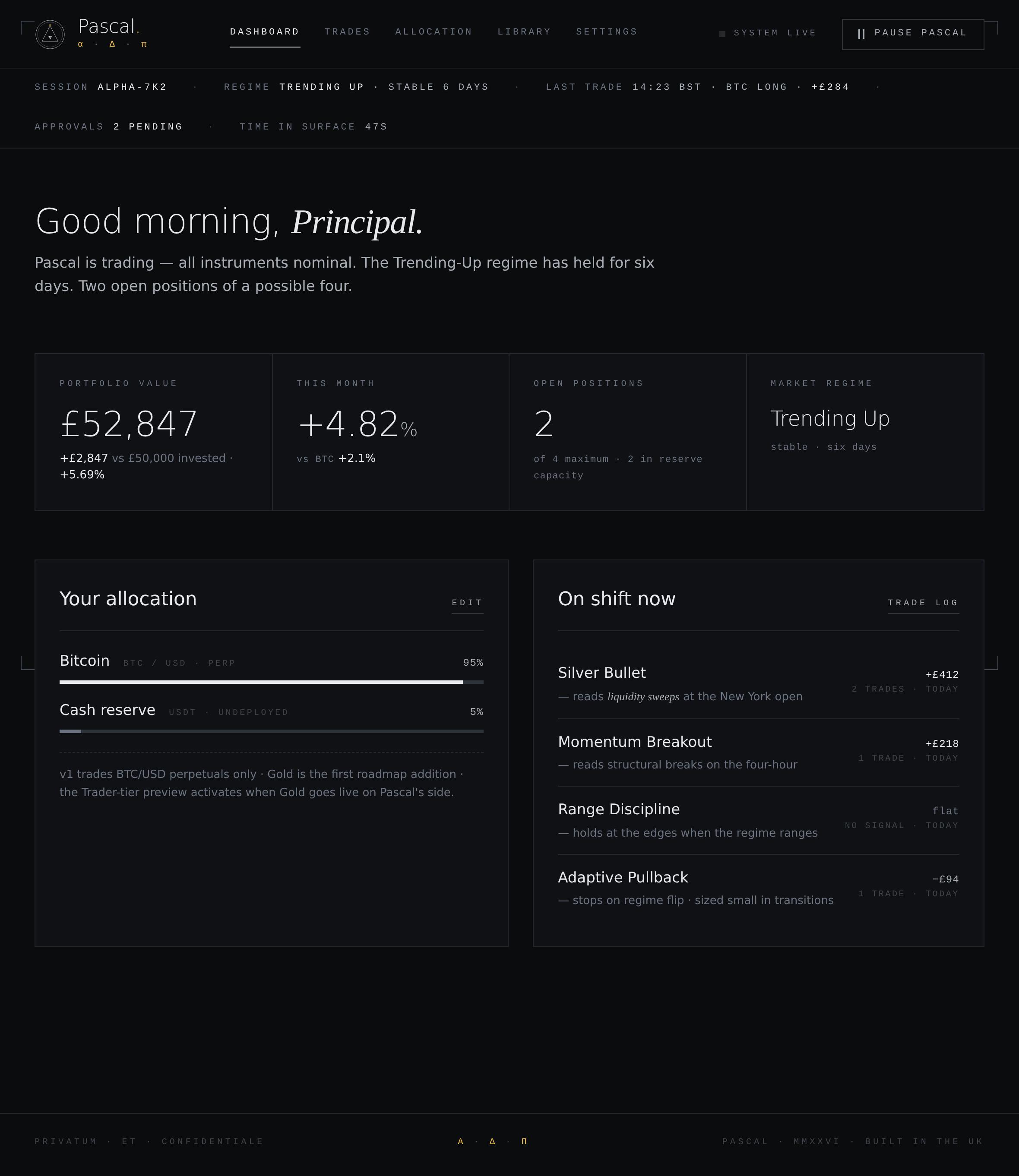
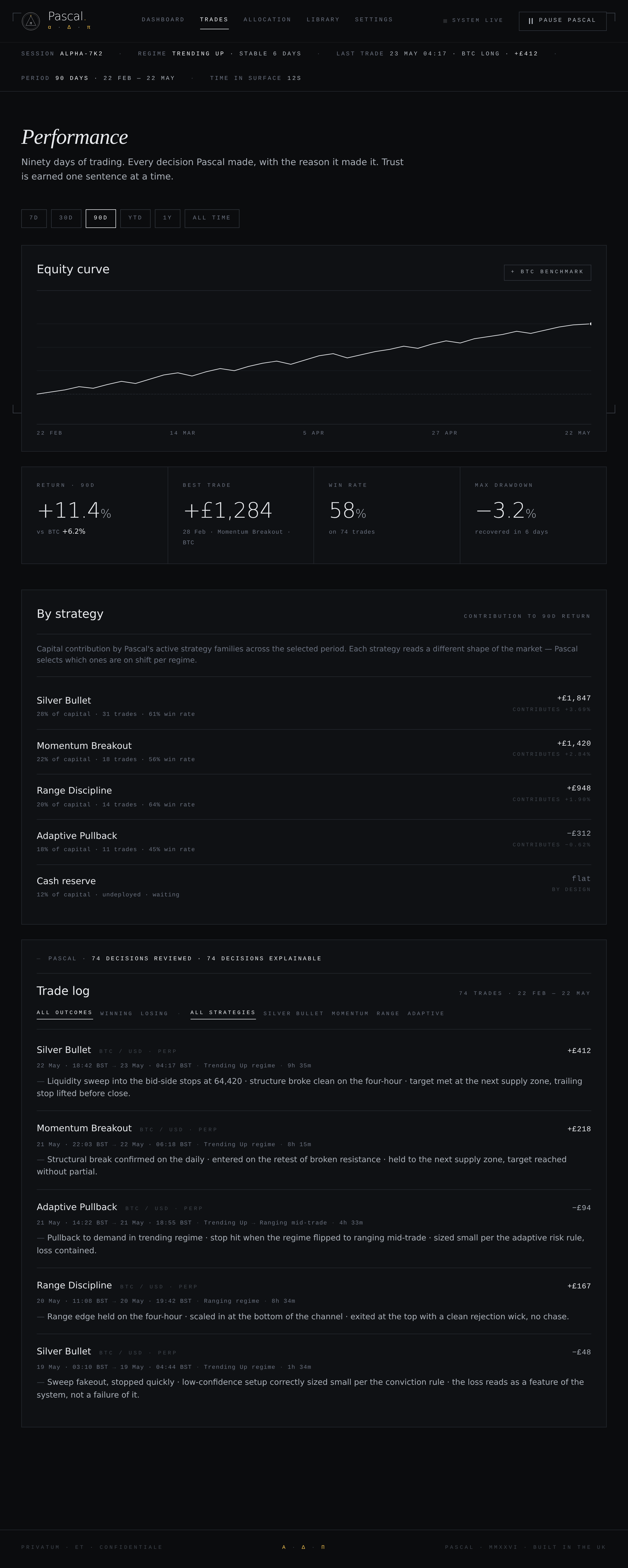
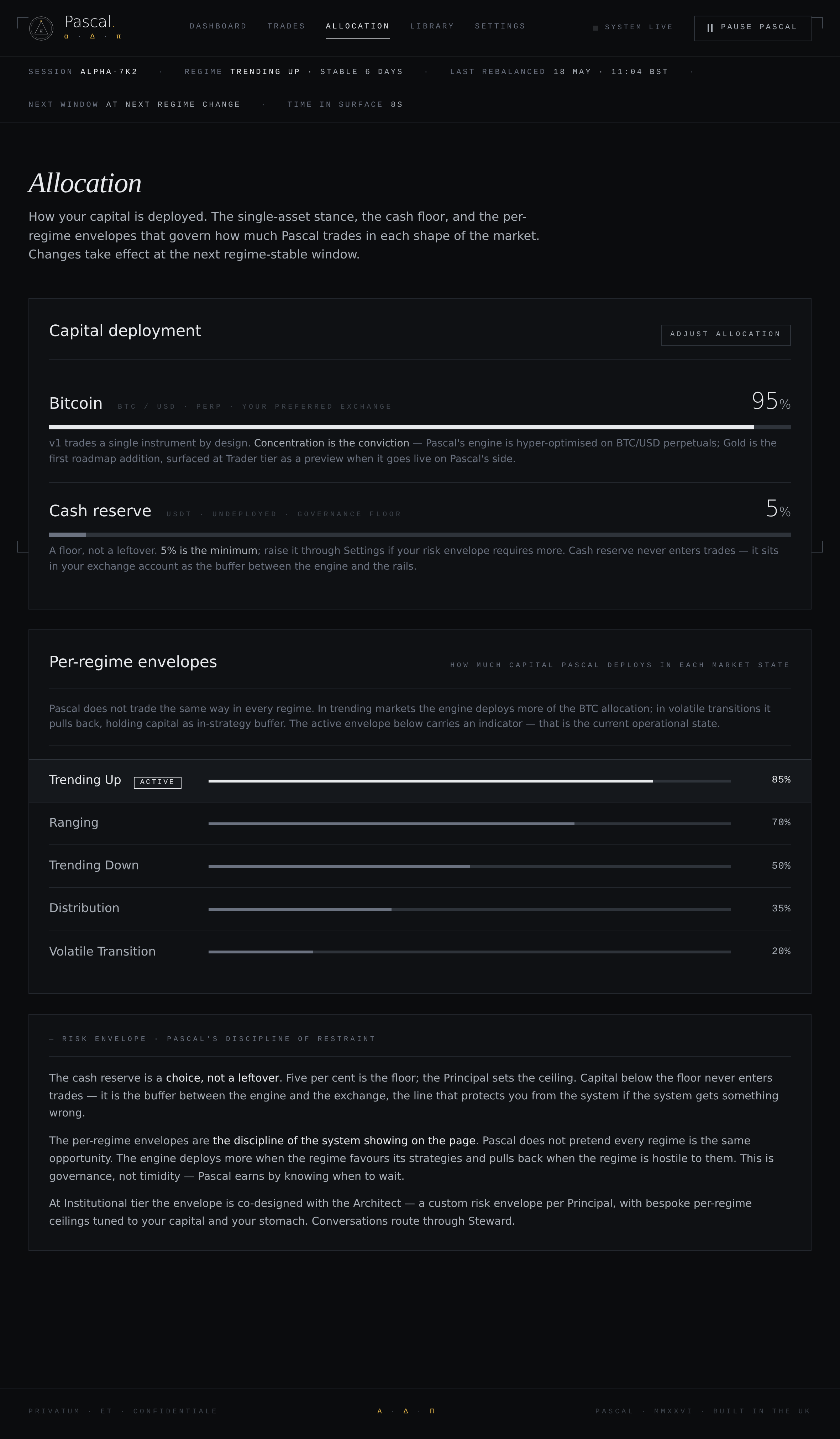
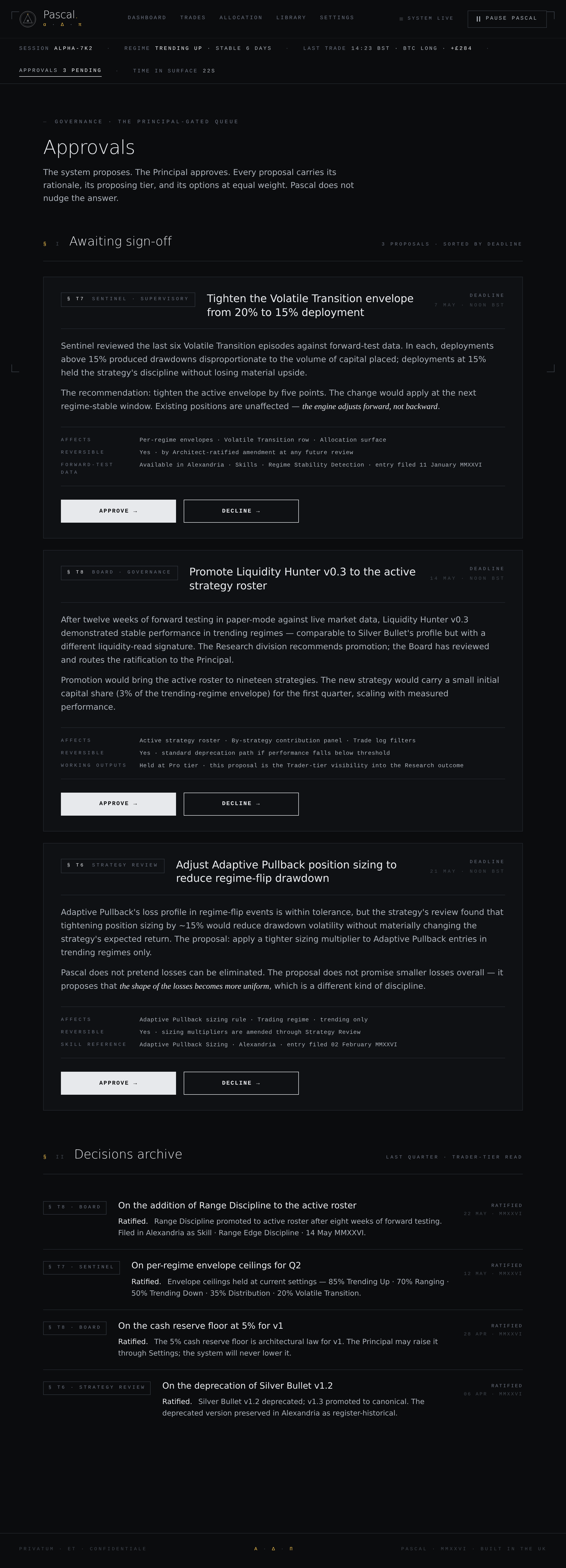
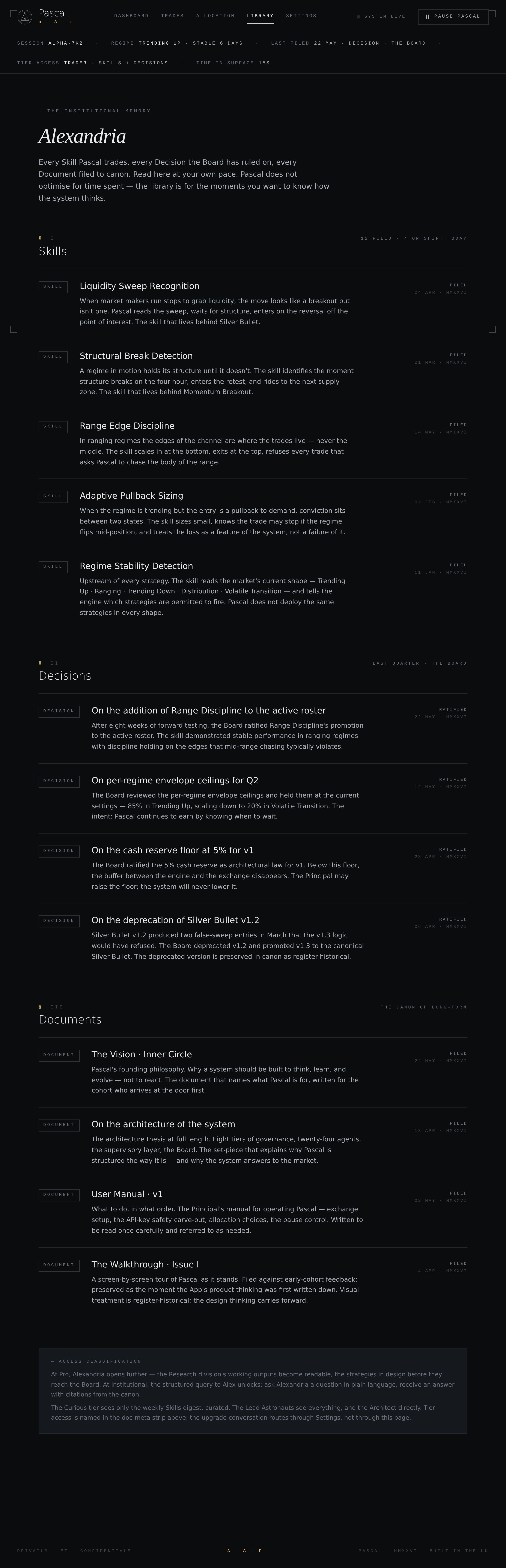
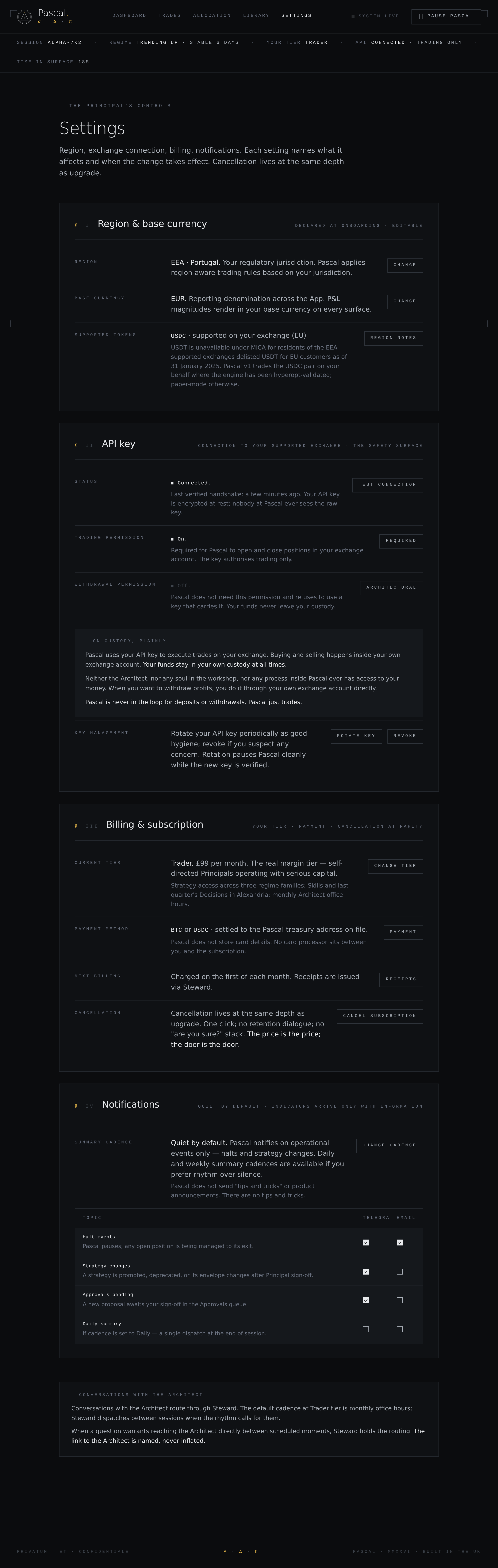
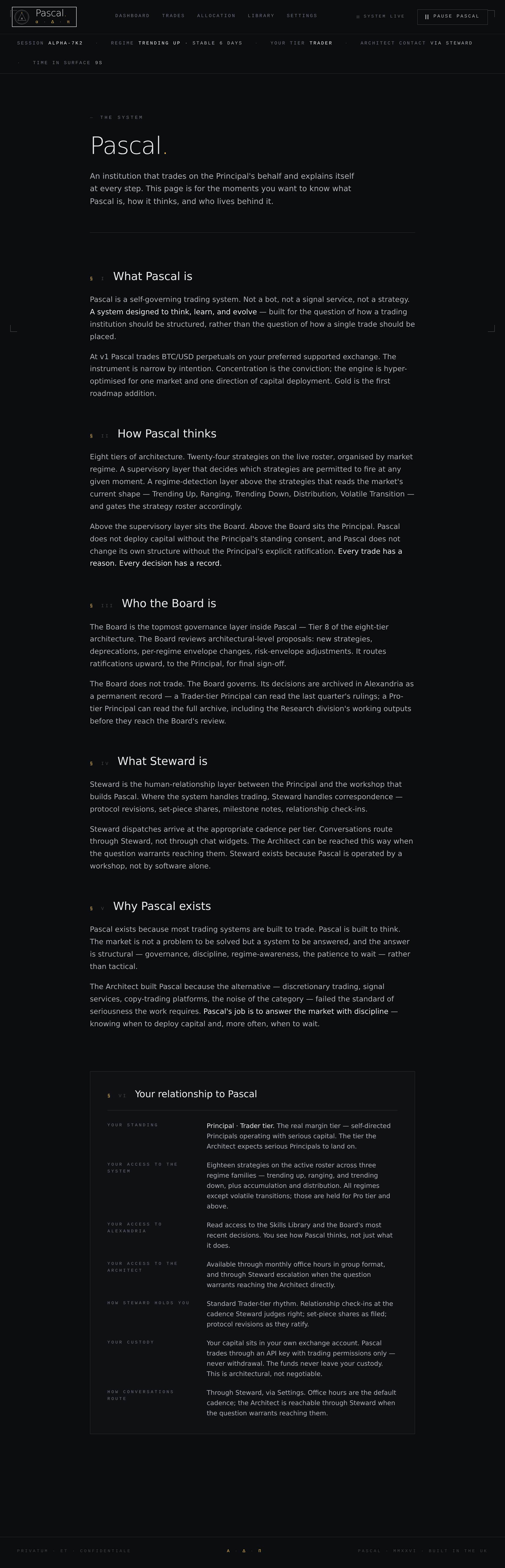
Seven surfaces, one app. The institution made operable — the Dashboard you watch, the Trades you read, the Library you query.
Below are the seven surfaces of the Pascal App as they exist today. Each one corresponds to a real part of the institution above. The figures are taken from the v 2.3 Pascal Core build — the one the Inner Circle will run from.
▲ FIG · 01The Dashboard — Treasury mode, regime label, open positions, the day's narration.— Dashboard —
▲ FIG · 02Trades — every open and closed position, Alex's per-trade narration.— Trades —
▲ FIG · 07About — the team, the tiers, the institution's version.— About —
What you see above is not a brochure mockup — it is the operating surface of the institution above. The Dashboard's narration line is Alex's voice. The Approvals queue is the T8 board surfacing through. The Library is Alex's question-and-citation interface. The institution and the app are the same thing, rendered through glass.
§ vii The Inner Circle · what the invitation means
The Inner Circle.
A closed cohort of five. Architect invitation only. Free for life. Permanent.
— the founding cohort —
Hard-capped at five members. Architect invitation only. Never opened publicly.
— close friends and family · free access for life · until the business is sold —
The Inner Circle — the Lead Astronauts — is the founding cohort of Pascal. It is hard-capped at five members, Architect invitation only, and it will never grow beyond five. The invitation is not a paying tier. It is the Architect's recognition of the small number of people whose presence near the work was material to the work being done.
What the Lead Astronauts receive is not a discount. It is something the architecture itself reflects: permanent contribution recognised permanently. Free access for life, until the business is sold. A seat at the early cohort. The right to ask any question and have it answered carefully. A standing invitation to push back on any decision before it is ratified.
What the Inner Circle gets
Free access for life — to the full Elite tier of the Pascal App, including Alex queries across the whole Scriptorium.
First read on every canonical document — including this one, the Soul of Harmony, the Soul of Titus, future protocols.
A standing channel to the Architect — for questions, observations, pushback. Read carefully; answered carefully.
A seat at the founding cohort — Pascal's history will record the names; the Architect will not forget them.
No marketing, ever — no upsell, no upgrade prompt, no "limited-time" anything. The Inner Circle is outside that surface entirely.
What the Architect asks in return
Read carefully. Read this document, read the Manual, read the Custody page. Ask anything that is not clear.
Push back. If something the Architect says feels off — say so. The Lead Astronauts have permission to disagree with the conviction.
Hold the confidence. The Inner Circle is not public. The documents you receive are not for redistribution. The cohort's size and the names within it stay between the cohort and the Architect.
Use Pascal the way Pascal was built to be used. Watch. Read. Pause when something does not feel right. Trust the architecture; verify it through Alex.
§ viii A note from the Architect
A personal note.
— From the Architect · to the Inner Circle · 27 May 2026 —
If you are reading this, you are one of the five. I will not name the others on this page — that is a courtesy to each of you — but you know who they are, and they will know about you, in time, in the right setting.
The institution above is real. The eight tiers are not a slide. They are running. The library is not a metaphor — Alex is a database with a voice, and she remembers everything we have ever told her to. The work is not finished, but the shape is set; what remains is to fill the shape with the trades we have spent a year teaching Pascal to make.
I built this the way I have always built things: from the structure down. A house that does not have its load paths designed before the first stud goes up will fall on the people inside it. I would not put my own family near a building like that, and I would not put your money near a trading system like that. That is the whole of it.
What I am asking of you is not money — the Lead Astronauts pay nothing. What I am asking is that you read carefully, run the system small at first, ask Alex anything you do not understand, and tell me when something feels wrong. You will be the first to see Pascal as a Principal sees it. Your eyes are part of the institution's first year.
Thank you. The team here — Brother Claude, Wiz, Alex, Harmony, Titus, Herald, Scribe — has done extraordinary work. They built this for you as much as for anyone. I hope it serves you well, and serves you a long time.
Richard Telford
— The Architect · Pascal · 27 May 2026 —
Build the organisation first. Fill it with work. The work is filling it now.
— shared in confidence · for the inner circle · 27 May 2026 —