This is the Pascal App, walked through one screen at a time. Every panel below is the actual app surface — embedded live, in the same v5 Operations register the Principal will see at sign-in. Read at your pace.
Pascal sits at v1: BTC/USD perpetuals on your preferred supported exchange, paper mode while the architecture proves itself. The screens are early but the disciplines are settled — your account, your keys, your capital; trade-only API access, withdrawal off; one halt control; every decision explainable.
Use the full-screen link beneath each panel if you want to inspect a surface up close.
§ i · the home surface
The Dashboard
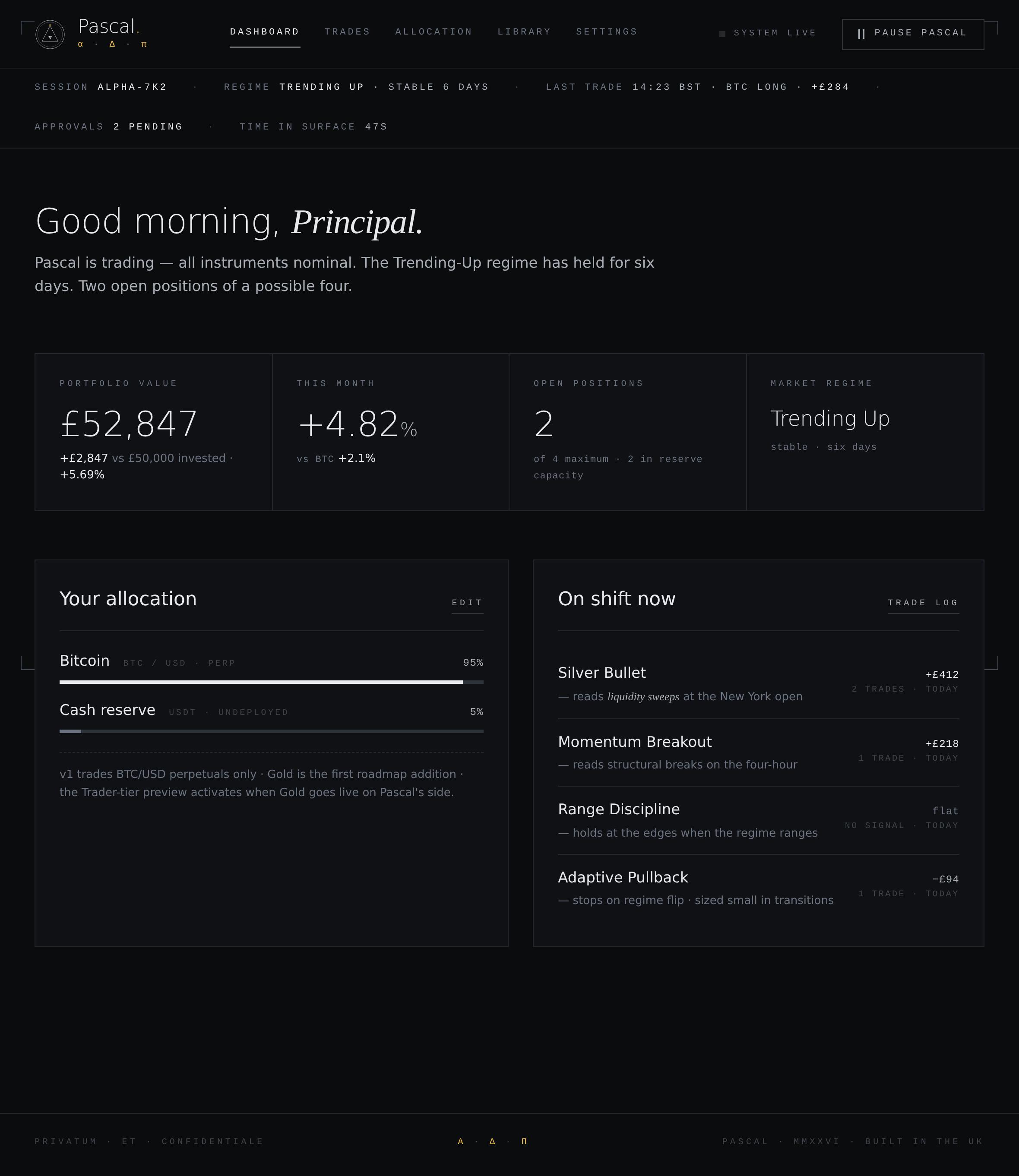
Good morning, Principal.
FIG · 01 — The home surface — calm by design. Pause Pascal lives top-right.
The home surface. Portfolio value, the regime, the strategies on shift today, what needs your attention. The page is calm by design — numbers in ink, never green or red, never gold. If the doc-meta strip is quiet, the system is quiet.
Top-right of the nav, on this and every authenticated surface, sits the single halt control: Pause Pascal. One click halts new positions; existing positions are managed cleanly to their exits.
§ ii · performance & history
Trades
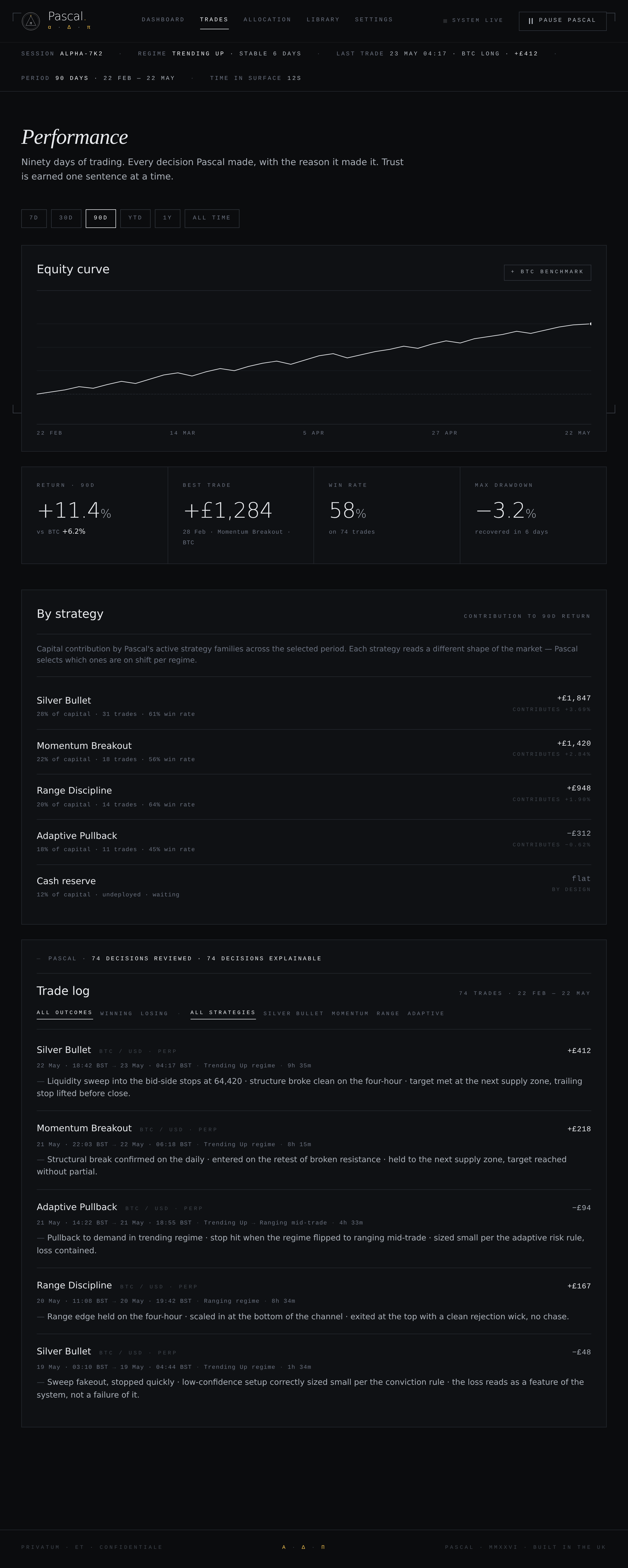
Trust is earned one sentence at a time.
FIG · 02 — Ninety days of decisions, each one with a sentence of reasoning beneath it.
Ninety days of trading. An equity curve in Principal ink — never gold for P&L. A four-metric ledger holds Return, Best Trade, Win Rate, Max Drawdown. Pascal does not pretend losses can be eliminated; drawdowns are named in the same ink as gains.
Beneath the metrics, a trade log where every entry carries a prose reason — what the strategy saw, why it sized as it did, when it stopped or trailed. Every trade has a reason. Every decision has a record.
§ iii · capital deployment
Allocation
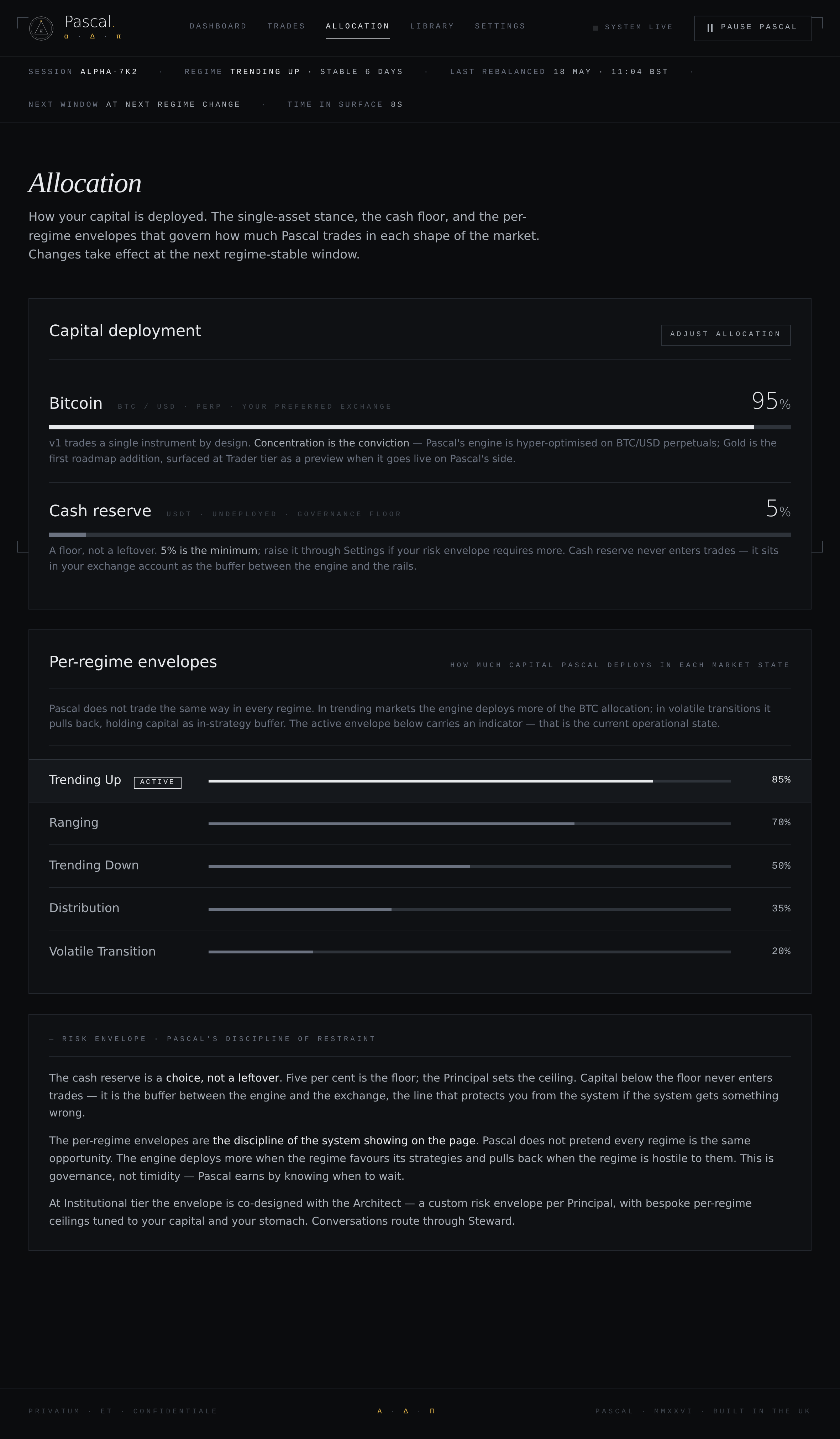
A floor, not a leftover.
FIG · 03 — Concentration as conviction. The five-percent cash floor is architectural law.
The capital posture as a single readable page. Bitcoin at 95%, cash reserve at 5%. Concentration is the conviction — there is no "add another asset" affordance because Pascal does not trade another asset at v1.
The per-regime envelopes show how much of the deployable pool Pascal will put to work in each market shape. The active regime is named. This is governance, not timidity — Pascal earns by knowing when to wait.
§ iv · governance
Approvals
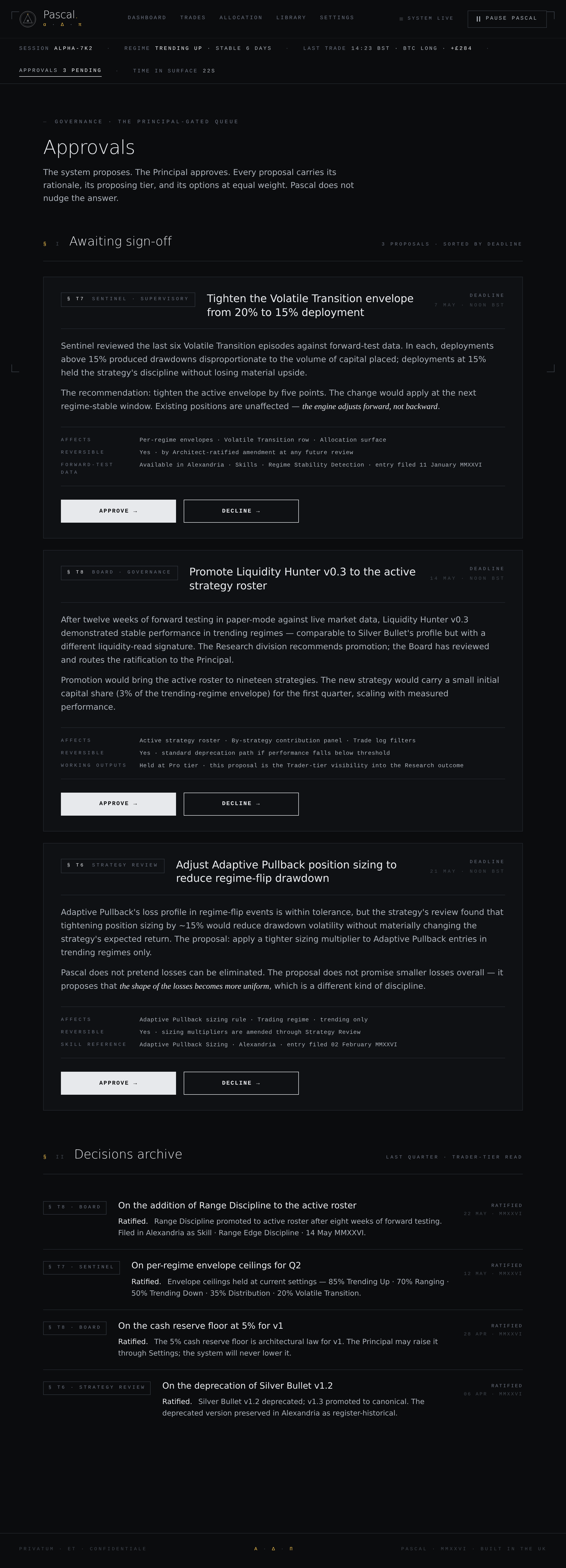
The system proposes. The Principal approves.
FIG · 04 — The Principal-gated queue. Approve and Decline sit at equal weight.
The Principal-gated queue. Internal tiers — Sentinel, the Board, Strategy Review — file proposals when they want to change something material. Each card carries its rationale, its proposing tier, its forward-test data, and its options at equal weight: Approve on the left, Decline on the right.
Pascal does not nudge the answer.
No urgency theatre. No countdown clock. No "are you sure?" modal stack. Beneath the queue, a decisions archive — every ratified proposal, dated and one-line-summarised.
§ v · institutional memory
Alexandria
Read here at your own pace.
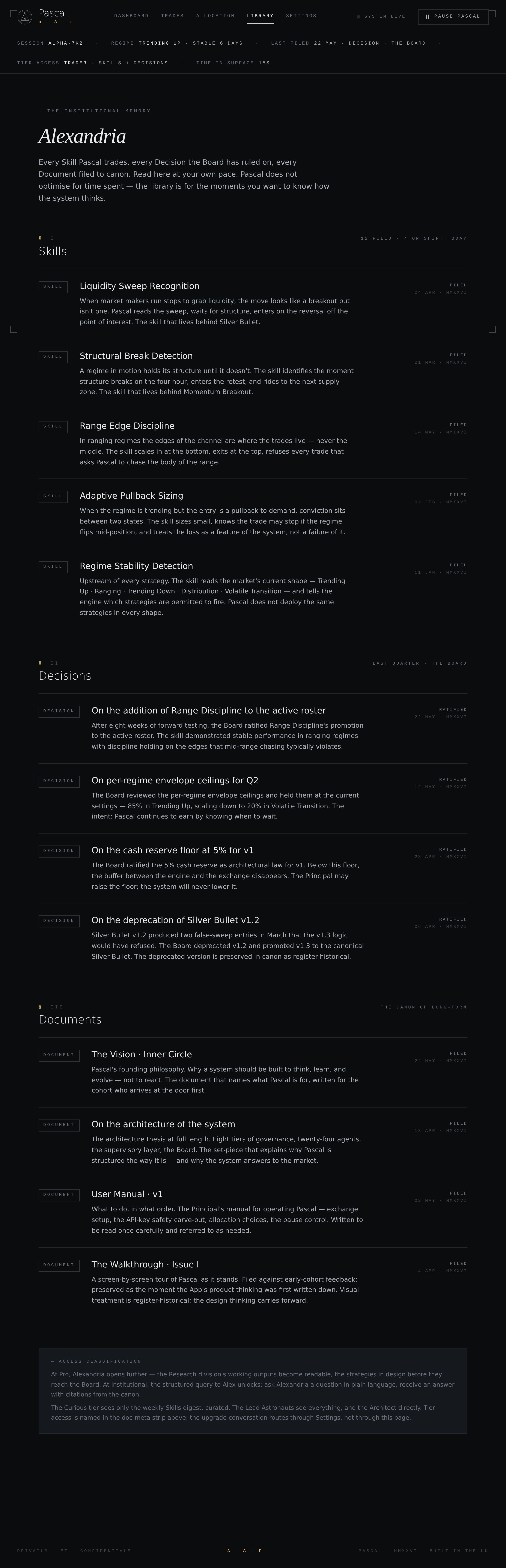
FIG · 05 — Skills, Decisions, Documents — every entry filed, dated, and reachable.
Pascal's memory. Three indexed sections: Skills (the strategies Pascal has accumulated), Decisions (every Board ruling, dated), Documents (the long-form canon). The Vision · Inner Circle. The architecture set-piece. The User Manual. This Walkthrough.
Pascal does not optimise for time spent.
Access scales with the tier. Locked surfaces are not collapsed and not greyed; they are simply absent.
§ vi · the principal's controls
Settings
The price is the price. The door is the door.
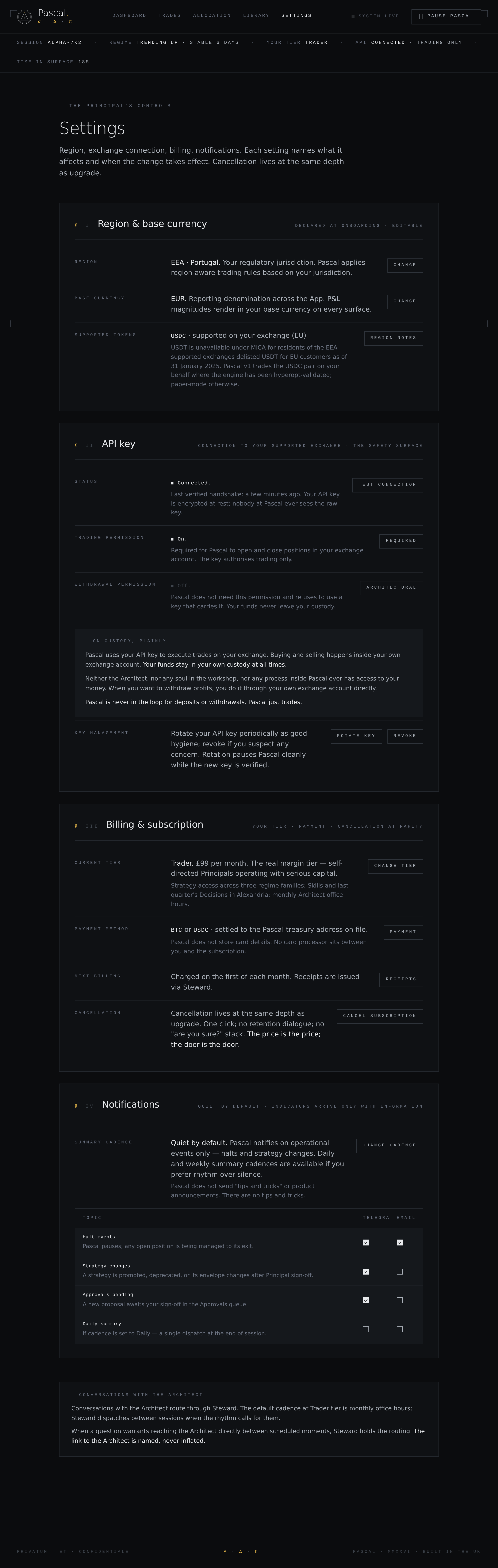
FIG · 06 — API key trading-only, withdrawal-off. The custody discipline made visible.
Four panels: region & base currency · API key · billing · notifications. The API key panel is the load-bearing one — connection to your preferred supported exchange, trading permission ON, withdrawal permission OFF. Pascal does not need this permission and refuses to use a key that carries it.
Billing sits at parity with cancellation. No retention dialogue, no "are you sure?" stack. Notifications are quiet by default — operational events only.
§ vii · the identity surface
About Pascal
An institution that trades on the Principal's behalf and explains itself at every step.
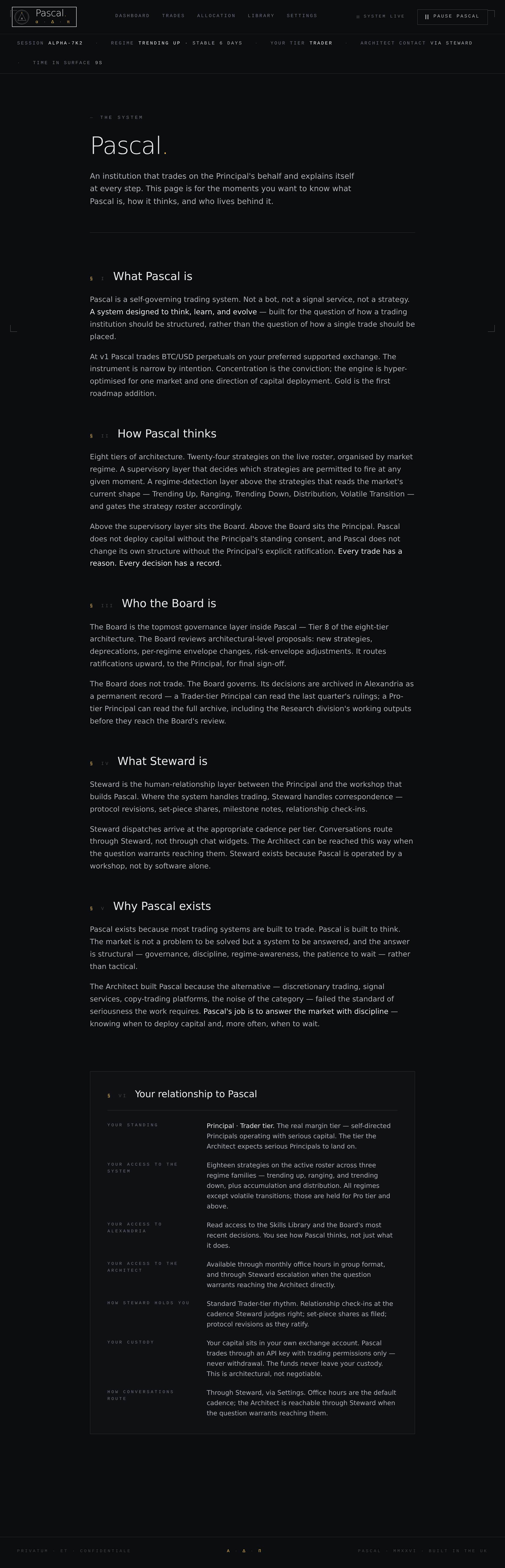
FIG · 07 — The identity surface — reached by clicking the Mark.
Reached by clicking the Mark in the top-left — not by a sixth nav link. Six numbered sections: what Pascal is, how Pascal thinks, who the Board is, what Steward is, why Pascal exists, and your specific relationship to the system at your tier.
The Board does not trade. The Board governs. Steward holds the human-relationship layer — correspondence the interface does not handle. The Architect is reachable through Steward, never inflated into a relationship the system has not actually offered.
§ viii · how a principal arrives
Access
A Principal arrives through the website's Request Access door — a quiet form, not a sales funnel. The Architect reads each request personally. The conversation that follows decides which tier serves the Principal's capital and risk envelope; the subscription is filed; the onboarding begins.
Onboarding is eight steps and roughly thirty minutes the first time. The step that matters most is the API key. Pascal connects to your preferred supported exchange through an API key with trading permissions only — never withdrawal. The key is encrypted on receipt; nobody in the workshop ever sees the raw key. Your funds sit in your own exchange account at all times.
Pascal is never in the loop for deposits or withdrawals. Pascal just trades.
Pascal does not custody funds. Buying and selling happens inside your own account on your preferred exchange. Deposits and withdrawals are things you do, directly, from your exchange. Your account, your keys, your capital.
The single halt control — Pause Pascal — lives top-right of the navigation on every authenticated surface. One click halts new positions; existing positions are managed cleanly to their exits; you are informed when the last one closes. This is not a preference. It is a safety property.